

General information — DesignersJoan Daemen, Vincent RijmenFirst published: 1998. Derived fromFieldSuccessorsAnubis, Grand Cru, KalynaCertificationAES winner, CRYPTREC, NESSIE, NSACipher detailsKey sizes128, 192 or 256 bits[Note 1]Block sizes128 bit[Note 2]StructureSubstitution–permutation networkRounds10, 12 or 14 (depending on key size). Best public cryptanalysis
Published attacks are computationally faster than a full brute-force attack, although none was computationally feasible as of 2023.[1]For AES-128, the key can be recovered with a computational complexity of 2126.1 using a biclique attack. For biclique attacks on AES-192 and AES-256, the computational complexities are 2189,7 and 2254,4 respectively. Related-key attacks can break AES-192 and AES-256 with complexities of 299.5 and 2176 in both time and data, respectively.[2]
Another attack was described in a blog post[3] and released as a preprint[4] in 2009. This attack targets AES-256 using only two related keys and requires 239 time to recover the full 256-bit key for a nine-round version, or 245 time for a ten-round version using a stronger related-subkey attack, or 270 time for an eleven-round version.
The Advanced Encryption Standard (AES), also known by its original name Rijndael (Dutch pronunciation: [ˈrɛindaːl]),[5] is a specification for the encryption of electronic data, established by the United States National Institute of Standards and Technology (NIST) 2001-ben.[6]
AES is a variant of the Rijndael block cipher[5] developed by two Belgian cryptographers, Joan Daemen and Vincent Rijmen, who submitted a proposal to the[7] to NIST for the AES selection process.[8] Rijndael is a family of ciphers with different key and block sizes. For AES, NIST selected three members of the Rijndael family, each with a 128-bit block size but with key lengths of 128, 192 or 256 bits.
AES was adopted by the U.S. government. It supersedes the Data Encryption Standard (DES),[9] published in 1977. The algorithm described by AES is a symmetric-key algorithm, meaning that the same key is used to encrypt and decrypt data.
In the United States, NIST announced AES as U.S. FIPS PUB 197 (FIPS 197) on 26 November 2001.[6] This announcement followed a five-year standardisation process in which fifteen competing designs were presented and evaluated before Rijndael was selected as the most suitable.[Note 3]
AES is included in the ISO/IEC 18033-3 standard. AES took effect as a U.S. federal government standard on 26 May 2002, after approval by the U.S. Secretary of Commerce Donald Evans. AES is available in many encryption packages and was the first publicly accessible cipher approved by the United States National Security Agency (NSA) for top secret information when used in an NSA-approved cryptographic module.[Note 4]
Definitive standards
The Advanced Encryption Standard (AES) is specified in each of the following
Description of the cipher
AES is based on a design principle known as a substitution–permutation network, and is efficient in both software and hardware.[11] Unlike its predecessor DES, AES does not use a Feistel network. AES is a variant of Rijndael with a fixed block size of 128 bits, and a key size of 128, 192 or 256 bits. In contrast, Rijndael per se is specified with block and key sizes that can be multiples of 32 bits, from 128 to 256 bits. Most AES calculations take place in a particular finite field.
AES operates on a 4 × 4 column-major array of 16 bytes called the b0,b1,…,b15 called the state:[Note 5]
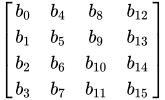
The key size used for AES specifies the number of transformation rounds that convert the input, called plaintext, into the final output, called ciphertext. The number of rounds is as follows:
- 10 rounds for 128-bit keys.
- 12 rounds for 192-bit keys.
- 14 rounds for 256-bit keys.
Each round consists of several processing steps, including one that depends on the encryption key itself. Reverse rounds convert ciphertext back into the original plaintext using the same encryption key.
High-level description of the algorithm
- KeyExpansion — round keys are derived from the cipher key using the AES key schedule. AES requires a separate 128-bit round-key block for each round, plus one additional block.
- Initial round-key addition:
- AddRoundKey — each byte of the state is combined with a byte of the round key using bitwise XOR.
- 9, 11 or 13 rounds:
- SubBytes — the non-linear substitution step in which each byte is replaced using a lookup table.
- ShiftRows — a transposition step in which the final three rows of the state are cyclically shifted by a specified number of positions.
- MixColumns — a linear mixing operation applied to the state's columns, combining the four bytes in each column.
- AddRoundKey
- Final round (making 10, 12 or 14 rounds in total):
- SubBytes
- ShiftRows
- AddRoundKey
The SubBytes step

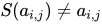
In the SubBytes step, each byte of the ai,j on a state array is replaced using the SubByte S(ai,j) eight-bit substitution box. Before round 0, the state array is simply the plaintext input. This operation provides the non-linearity of the cipher. The S-box is based on the multiplicative inverse over GF(28), known to have good non-linearity properties. To avoid attacks based on simple algebraic properties, the S-box combines the inverse function with an invertible affine transformation. The S-box is also chosen to avoid fixed points (so that confusion), meaning S(ai,j)≠ai,j, and opposite fixed points, meaning S(ai,j)⊕ai,j≠FF16. During decryption, the InvSubBytes step (the inverse of SubBytes) is used. This first reverses the affine transformation, then takes the multiplicative inverse.



The ShiftRows step

The ShiftRows step operates on state rows, cyclically shifting each row's bytes by a particular offset. In AES, the first row remains unchanged. Each byte in the second row shifts one position to the left. The third and fourth rows shift by two and three positions respectively.[Note 6] In this way, each column of the output state from the ShiftRows step contains bytes from each column of the input state. This avoids encrypting columns independently, which would reduce AES to four independent block ciphers.
The MixColumns step


In the MixColumns step combines the four bytes of each state column using an invertible linear transformation. The MixColumns function takes four input bytes and produces four output bytes, with each input byte affecting all four output bytes. Together with ShiftRows, MixColumns provides diffusion in the cipher.
Each column is transformed using a fixed matrix; left-multiplying the column by this matrix gives its new state value:
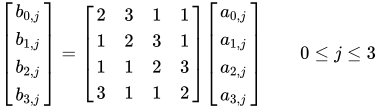
Matrix multiplication consists of multiplying and adding entries. Entries are bytes treated as polynomial coefficients of order x7. Addition is simply XOR. Multiplication is modulo the irreducible polynomial x8+x4+x3+x+1. In bit-by-bit processing, shifting is followed by a conditional XOR 1b-vel16 when the shifted value exceeds FF16 (overflow is corrected by subtracting the generating polynomial). These are special cases of ordinary multiplication in GF⁇(28).



More generally, each column is treated as a polynomial GF⁇(28)and then multiplied modulo 0116⋅z4+0116by a fixed polynomial c(z)=0316⋅z3+0116⋅z2+0116⋅z+0216. The coefficients are represented by their hexadecimal equivalents of the binary bit-polynomial representation GF⁇(2)[x]. The MixColumns step can also be understood as multiplication by the particular MDS matrix on a finite field GF⁇(28). The process is described in greater detail in the article Rijndael MixColumns.



The AddRoundKey

In the AddRoundKey step combines the subkey with the state. For each round, a subkey is derived from the main key using Rijndael key schedule; each subkey is the same size as the state. The subkey is added by combining each state byte with the corresponding subkey byte using bitwise XOR.
Optimising the cipher
On systems using 32-bit or larger words, encryption can be accelerated by combining the SubBytes and ShiftRows steps with the MixColumns step through a series of table lookups. This needs four 256-entry tables of 32-bit values, using 4096 bytes in total. A round can then use 16 table lookups and 12 32-bit XOR operations, followed by four 32-bit XOR operations for the AddRoundKey step.[12] Alternatively, table lookup can use a single 256-entry, 32-bit table occupying 1024 bytes, followed by circular rotation operations.
With a byte-oriented approach, the SubBytes, ShiftRows, and MixColumns steps can be combined into a single round operation.[13]
Security
The National Security Agency (NSA) reviewed all AES finalists, including Rijndael, and stated that each was sufficiently secure for unclassified U.S. government data. In June 2003, the U.S. government announced that AES could protect classified information:
The design and strength of all AES key lengths — 128, 192 and 256 bits — were judged sufficient to protect classified information up to SECRET. TOP SECRET information required either 192-bit or 256-bit keys. Implementations intended to protect national security systems or information had to be reviewed and certified by the NSA before acquisition and use.[14]
AES uses 10 rounds for 128-bit keys, 12 for 192-bit keys and 14 for 256-bit keys.
Known attacks
For cryptographers, a cryptographic 'break' is any method faster than a brute-force attack— trying decryption with every possible key in succession . A break can therefore include results that are infeasible with contemporary technology. Although impractical, theoretical breaks can reveal patterns of weakness. The largest publicly known successful brute-force attack against a widely deployed block cipher targeted a 64-bit RC5 key by distributed.net 2006-ban.[15]
The key space doubles with every additional key bit. If all possible keys are equally likely, the average brute-force search time also doubles. The work therefore grows exponentially with key length. Key length alone does not guarantee security: some ciphers with very long keys have still proved vulnerable.
AES has a relatively simple algebraic framework.[16] In 2002, a theoretical attack called theXSL attackwas announced by Nicolas Courtois and Josef Pieprzyk, suggesting a weakness partly due to the low algebraic complexity of its non-linear components.[17] Subsequent papers showed that the attack, as originally presented, was impractical; see XSL attack on block ciphers.
During AES selection, developers of competing algorithms expressed concern about using Rijndael in security-critical applications.[18] However, in October 2000, at the end of the selection process, Bruce Schneier, a developer of the competing algorithm Twofish, wrote that successful academic attacks might eventually be developed, but doubted that an attack would ever make it practical to read Rijndael-encrypted traffic.[19]
By 2006, the best-known attacks covered seven rounds for 128-bit keys, eight for 192-bit keys and nine for 256-bit keys.[20]
Until May 2009, the only successful published attacks against full AES were side-channel attacks on particular implementations. In 2009, a new related-key attack was found that exploited the simplicity of the AES key schedule, with a complexity of 2119. In December 2009 this was improved to 299.5.[2] This followed an attack discovered earlier in 2009 by Alex Biryukov, Dmitry Khovratovich, and Ivica Nikolić, with complexity 296 for one out of every 235 keys.[21] Related-key attacks are not a concern for a correctly designed cryptographic protocol that prevents related keys, essentially by restricting the attacker's ability to choose keys with such relationships.
Another attack was discussed by Bruce Schneier in a blog post[3] on 30 July 2009 and released as a preprint[22] on 3 August 2009. This attack by Alex Biryukov, Orr Dunkelman, Nathan Keller, Dmitry Khovratovich, and Adi Shamir, targets AES-256 using only two related keys and 239 time to recover the full 256-bit key for a nine-round version, or 245 time for a ten-round version using a stronger related-subkey attack, or 270 time for an eleven-round version. AES-256 uses fourteen rounds, so these attacks do not apply to full AES.
The practicality of attacks using stronger related-key assumptions has been criticised,[23] for example in Vincent Rijmen's 2010 paper on chosen-key relationships against AES-128.[24]
In November 2009, the first known-key distinguishing attack on a reduced eight-round version of AES-128 was published as a preprint.[25] This known-key distinguishing attack improves on rebound or start-from-the-middle attacks on AES-like permutations, treating two consecutive rounds as a Super-S-box. It works on eight-round AES-128 with a time complexity of 248, and memory complexity of 232. AES-128 uses ten rounds, so this is not an attack on full AES-128.
The first key-recovery attacks on full AES were developed by Andrey Bogdanov, Dmitry Khovratovich and Christian Rechberger and published in 2011.[26] The attack uses a biclique attack and is approximately four times faster than brute force. It requires 2126.2 operations to recover an AES-128 key. For AES-192 and AES-256, 2190.2 and 2254,6 operations are required, respectively. This was subsequently improved to 2126,0 for AES-128, 2189,9 for AES-192 and 2254.3 for AES-256 in a 2015 paper by Biaoshuai Tao and Hongjun Wu,[27]reported in this article as the best key-recovery results against AES at that time.
This is a small gain: brute-forcing a 126-bit key rather than a 128-bit key would still require an impractical amount of work on foreseeable hardware. The authors also calculated that their best attack on AES with a 128-bit key required storing 288 bits of data — approximately 38 trillion terabytes, more than the total data stored on the world's computers in 2016.[28] A 2015 paper subsequently improved space complexity to 256 bits,[27] or approximately 9007 terabytes, while maintaining a time complexity of roughly 2126).
According to the Snowden documents, the NSA was researching whether a cryptographic attack based on tau statistic could help break AES.[29]
At the time covered by this article, no practical attack was known that could read correctly implemented AES-encrypted data without the key.[citation needed]
Side-channel attacks
Side-channel attacks do not attack the cipher in the black box, and therefore fall outside the classical definition of cryptographic security, but matter in practice. They target hardware or software implementations that inadvertently leak information. Many such attacks are known against different AES implementations.
In April 2005, D. J. Bernstein announced a cache-timing attack against a custom server using OpenSSLAES encryption.[30] The attack required more than 200 million chosen plaintexts.[31] The custom server deliberately exposed detailed timing information, including the number of machine cycles used for encryption. Bernstein noted that reducing timestamp precision or removing server timestamps would not eliminate the attack: a client could measure round-trip time locally and compensate for added noise by averaging more samples.[30]
In October 2005, Dag Arne Osvik, Adi Shamir and Eran Tromer presented a paper describing several cache-timing attacks against AES implementations in OpenSSL and Linux's dm-crypt partition encryption feature.[32] One attack obtained an entire AES key after just 800 encryption-triggering operations, taking 65 milliseconds in total. It required the attacker to run programs on the same system or platform as the AES implementation.
In December 2009, an attack was published against some hardware implementations using differential fault analysis and permits key recovery with a complexity of 232.[33]
In November 2010, Endre Bangerter, David Gullasch and Stephan Krenn published a practical approach to near-real-time recovery of AES-128 secret keys without requiring ciphertext or plaintext. The approach also works against table-based AES-128 implementations such as OpenSSL.[34] Like several earlier attacks, it requires the ability to execute unauthorised code on the system performing AES encryption. Malware infection can provide this capability without obtaining control of the root account.[35]
In March 2016, C. Ashokkumar, Ravi Prakash Giri and Bernard Menezes presented a side-channel attack capable of recovering a complete 128-bit AES key from only six or seven plaintext/ciphertext blocks, compared with earlier work requiring between one hundred and one million encryptions.[36] The proposed attack requires ordinary user privileges and key-retrieval algorithms that run in less than a minute.
Many modern CPUs include hardware instructions for AES, which help defend against timing-based side-channel attacks.[37][38]
Quantum attacks
Az AES-256-ot annak tekintik quantum-resistant, providing resistance to quantum search comparable to AES-128 against conventional attacks, at 128 bits of security. Under the quantum-search model discussed here, AES-192 and AES-128 offer lower security margins: approximately 96 and 64 bits respectively.[39][40]
NIST/CSEC validation
The Cryptographic Module Validation Program (CMVP) is jointly operated by the U.S. government's National Institute of Standards and Technology (NIST) Computer Security Division and the Communications Security Establishment (CSE) of the Government of Canada. Cryptographic modules validated under NIST's FIPS 140-2 are required by the U.S. government for encrypting information classified as Sensitive But Unclassified (SBU) or above. The historical NSTISSP No. 11 policy distinguished NSA certification for products protecting classified information from NIST FIPS 140-2 certification for products protecting sensitive information.[41]
The Government of Canada also recommends using FIPS 140 validated cryptographic modules in its departments' unclassified applications.
Although NIST publication 197, FIPS 197, specifies AES itself, vendors typically approach CMVP under FIPS 140 and request validation of multiple algorithms, such as Triple DES or SHA1, together. Individual FIPS 197 validation listings are therefore uncommon. AES validation is generally recorded as a FIPS-approved algorithm, with its certificate number, within the validated cryptographic module listing.
The Cryptographic Algorithm Validation Program (CAVP)[42] provides independent validation of correct AES implementation. Successful implementations are listed on the NIST validation website.[43] Such testing was a prerequisite for FIPS 140-2 module validation. Passing CAVP alone does not establish that an entire cryptographic module is secure or approved for protecting government data; module validation and any applicable separate approval remain distinct requirements.[41]
FIPS 140-2 validation is both technically and financially demanding.[44] It involves a standard test suite and source-code review over several weeks. Testing through an accredited laboratory can be costly, for example substantially more than USD30.000)[44] and excludes the time required to write, test, document and prepare the module. Changes after validation can require resubmission, ranging from paperwork updates to extensive retesting when security functions are affected.
Test vectors
Test vectors give known encryption results for specified inputs and keys. NIST distributes AES reference cases as AES Known Answer Test (KAT) vectors.[Note 7]
Performance
High speed and low RAM requirements were AES selection criteria. AES performs across a broad range of hardware, from eight-bit smart cards to high-performance computers.
A Pentium Pro, AES encryption requires 18 clock cycles per byte (cpb),[45] equivalent to approximately 11 MiB/s on a 200 MHz processor.
On Intel Core and AMD Ryzen CPUs supporting AES-NI instruction-set extensions, throughput can reach several GiB/s.[46] On an Intel Westmere CPU, AES-NI encryption takes approximately 1.3 cpb for AES-128 and 1.8 cpb for AES-256.[47]
Implementations
See also
- AES modes of operation
- Disk encryption
- Whirlpool — a hash function created by Vincent Rijmen and Paulo S. L. M. Barreto
- List of free and open-source software packages
Notes
- Rijndael supports key sizes of 128, 160, 192, 224 and 256 bits, but the AES standard specifies only 128, 192 and 256 bits.
- Rijndael supports block sizes of 128, 160, 192, 224 and 256 bits for all key sizes, but AES specifies only a 128-bit block size.
- See Advanced Encryption Standard process for further details.
- See AES security below.
- Large-block Rijndael variants use arrays with additional columns but always four rows.
- Rijndael variants with larger block sizes use slightly different shifts. For 128-bit and 192-bit blocks, the shift pattern is the same. Row nis cyclically shifted left by n−1bytes. For a 256-bit block, the first row is unchanged and the next rows shift by one, three and four bytes. This applies to Rijndael with 256-bit blocks, not AES, which does not use that block size.
- AES Known Answer Test (KAT) vectors are available as ZIP files from the NIST website here Archived 2009-10-23 a Wayback Machine


Source: Wikipedia